Dr Forest
Organic All-Purpose Fertiliser 6-6-6 | Vegan, Fish Blood & Bone Alternative
Organic All-Purpose Fertiliser 6-6-6 | Vegan, Fish Blood & Bone Alternative
Couldn't load pickup availability
Vegan all-purpose fertiliser 6-6-6 — a low-odour alternative to fish, blood and bone
Dr Forest All-Purpose 6-6-6 is a vegan, low-odour all-purpose fertiliser made with organic ingredients — eleven plant and mineral inputs across three release speeds, in a balanced 6-6-6 NPK. It feeds the whole garden from one application every four to six weeks, and because it carries no blood, bone or fish, it has only a mild earthy smell. Handcrafted in small batches in Stockport.
The balanced ratio is deliberate. Equal nitrogen, phosphorus and potassium mirrors what diverse plants in active growth actually withdraw from the soil, rather than the high-nitrogen profile most all-purpose feeds inherit from farm research. The immediate mineral fraction feeds within 48 hours; the Cambridgeshire plant meals feed for 6–8 weeks; Yorkshire Polyhalite extends the tail to 60 days. Every nutrient arrives from more than one source, at different speeds.
It is also a proper alternative to fish, blood and bone for gardeners who want an organic feed without the animal inputs or the smell. Phosphorus and nitrogen come from plant meals, not slaughterhouse by-products, so it suits vegan growers and stays pleasant to use in pots, beds and near the back door — with far less appeal to the cats and foxes that dig where fish-based feeds have been spread.
What it does across the whole garden
- Deep, dark foliage — sustained nitrogen from Cambridgeshire plant extracts builds chlorophyll without the flush-and-crash of soluble feeds.
- Roots that anchor — three phosphorus sources at different release speeds keep root tips dividing from transplant through to harvest.
- Bigger flowers, better fruit — chloride-free potassium drives stomatal control and sugar transport for deeper flavour, stronger colour and higher bud count.
- Walls that hold — four calcium sources, continuously supplied. No blossom end rot, no tip burn, no post-rain collapse. Calcium is immobile, so it must always be present.
- Low odour, no vermin — a mild earthy smell that fades once watered in, and none of the fishy scent that draws cats and foxes to fish, blood and bone.
- A richer soil every year — fermented biochar, humic acid and Scottish seaweed build permanent microbial habitat with every feed.
Dr Forest All-Purpose vs fish, blood and bone
Dr Forest All-Purpose 6-6-6
- Eleven ingredients across three release speeds — feeds for 6–8 weeks from one application.
- Chloride-free potassium, four calcium sources and three magnesium sources — properly balanced secondary nutrition.
- Vegan, plant-and-mineral based. No blood, bone, fish or feather meal.
- Low odour. A mild earthy smell that disperses once watered in.
- Little appeal to cats, foxes or vermin around beds and containers.
- Builds soil biology — fermented biochar, humic acid and seaweed leave the soil more alive each season.
Traditional fish, blood and bone
- Three ingredients, essentially one release speed — an early flush, then a gap.
- Low, unbalanced potassium and little usable magnesium or sulphur.
- Contains slaughterhouse and fish-processing by-products — not suitable for vegan growers.
- Strong, lingering fishy smell many gardeners dislike indoors and out.
- That smell attracts cats and foxes that dig up beds and freshly planted pots.
- Adds little permanent organic matter or microbial habitat.
Made by growers. Backed by science. Named after Joe's grandfather Dr Forrest (two Rs), a GP near Preston who kept a back-garden plot for the runner beans he turned into piccalilli. Developed in Stockport through hands-on growing trials and published plant-nutrition research. Browse the full Dr Forest range, or read our guide to what a fertiliser actually is.
All eleven ingredients — what each one does and why it is here
Nothing is filler. The two primary NPK carriers, Nitrogen Plant Extract and Phosphorous Plant Meal, are both Cambridgeshire-sourced and together make up roughly 68% of the formula by weight. The secondary mineral complex is mined in North Yorkshire. Every ingredient has a specific, research-backed job, and not one is an animal by-product.
Nitrogen Plant Extract
Cambridgeshire · plant-derived · controlled release. The primary nitrogen carrier at 12% N, the largest single share of the blend. Mineralises through microbial protease activity over 6–8 weeks for sustained background nitrogen without nitrate spikes. Also contributes 3% P₂O₅ and 4% K₂O as secondary nutrients.
Phosphorous Plant Meal
Cambridgeshire · calcined plant meal · moderate release. The primary phosphorus carrier at roughly 15% P₂O₅, supporting ATP synthesis, root-tip cell division and fruit set. At 9% CaO it adds to the calcium profile. Mineralises across the full growth cycle without zinc and iron antagonism or mycorrhizal suppression.
Micronised Rock Phosphate
Mineral · slow reserve. At 31% P₂O₅ the most concentrated phosphorus source in the formula and a long-term reservoir. Micronisation greatly increases surface area versus standard grades. At 49% Ca it is the largest single calcium source, giving phosphorus at three different release speeds across the season.
Yorkshire Polyhalite
North Yorkshire · slow release. A uniquely British mineral supplying four nutrients from one crystal: 14% K₂O, 17% CaO, 6% MgO and 48% SO₃, mined from over 1,000 metres below the North Sea. It extends the potassium feeding window by 50–60 days while supplying sustained calcium, magnesium and sulphur.
Sulphate of Potash
Mineral · immediate release. Fast-acting potassium at 50% K₂O, delivering K and S within days. Chloride-free, where muriate of potash causes tip burn and osmotic stress across many crops. Activates stomatal regulation, sugar transport and cell-wall synthesis straight away, bridging the gap before Polyhalite builds.
Gypsum (Calcium Sulphate)
Mineral · fast–moderate release. Supplies calcium and sulphur together as sulphate, both immediately plant-available. Calcium is immobile in the phloem and must be continuously supplied; deficiency causes blossom end rot and poor cell-wall integrity. Gypsum delivers calcium without raising soil pH, so it is safe on alkaline UK soils.
Micronised Magnesium Mineral
Mineral · fast release. Magnesium is the central atom in every chlorophyll molecule and a cofactor in ATP synthesis. At roughly 16.7% Mg this is the primary magnesium source; micronisation speeds correction of interveinal chlorosis. UK soils are chronically magnesium-deficient (DEFRA, 2016).
Magnesium Sulphate
Mineral · immediate release. The fastest-acting magnesium source, supplying Mg and S within days. Critical during rapid early-season growth when magnesium demand peaks and UK soils cannot release it quickly enough.
Seaweed (Scotland)
Hand-harvested. Provides cytokinins that delay leaf senescence, betaines for osmotic adjustment under drought, and mannitol that feeds beneficial rhizobacteria. Supplies trace minerals, natural auxins and alginates that improve soil structure and stress tolerance.
Fermented Biochar
British hardwood · fermented · activated. Creates a permanent porous scaffold in the root zone that holds water and nutrients between waterings. Fermentation pre-loads the surface with beneficial microbes. Trial work shows biochar raises plant-available potassium retention by 18–35% under leaching conditions.
Humic Acid
Chelates iron, manganese and other micronutrients into plant-available forms across a wide pH range, and increases root proton-pump activity. Research shows humic acid raises total soil bacterial biomass by 30–60% and stimulates mycorrhizal colonisation by 25–40%.
The strong odour of traditional organic feeds comes from animal proteins — dried blood, bone meal and fish meal breaking down. This blend carries none of those. Its nitrogen comes from a plant protein concentrate and its phosphorus from calcined plant meal, so the finished product has only a mild earthy smell that fades once watered in.
How to use: application rates, feeding schedules and a step-by-step guide
Grams and millilitres are interchangeable. Measure by weight on a kitchen scale or by volume with a spoon or jug. A level tablespoon is roughly 8–10g.
Step-by-step application
- Water first. Make sure soil or compost is moist before applying. The mineral fraction needs moisture to dissolve and reach the roots.
- Sprinkle evenly over the root zone. Spread across the full root area, not just at the stem base. Keep it off leaves and stems.
- Lightly fork in. Work into the top 2–3 cm. The biology lives in the top layer, so avoid deep burial.
- Water in thoroughly. In containers, water until it runs from the base. In open ground, apply before rain where possible.
Vegetables and salads
| Plant | Rate /m² | Frequency |
|---|---|---|
| Tomatoes | 70–80g | Every 4 weeks |
| Courgettes & squash | 70–80g | Every 4 weeks |
| Peppers & chillies | 65–75g | Every 4 weeks |
| Brassicas (cabbage, kale, broccoli) | 70–80g | Every 4 weeks — heaviest N feeders |
| Runner & French beans | 50–60g | Every 5–6 weeks |
| Peas | 25–35g | Every 6–8 weeks — peas fix their own N |
| Beetroot & chard | 50–60g | Every 5 weeks |
| Leeks & onions | 60–75g | Every 4–5 weeks |
| Salad leaves | 35–40g | Every 4–5 weeks (cut-and-come-again) |
| Potatoes | 70–80g | At planting, then every 4 weeks until foliage dies back |
Soft fruit
| Plant | Rate /m² | Timing |
|---|---|---|
| Strawberries | 55–65g | March and after the first flush |
| Raspberries | 60–70g | March, June and post-harvest. Three applications. |
| Black & redcurrants | 65–75g | March, June, post-harvest. Heaviest soft-fruit feeders. |
| Gooseberries | 60–70g | March and after fruiting (Jul–Aug) |
| Blueberries | 40–50g | March and June. Acidify soil to pH 4.5–5.5 separately. |
Shrubs, perennials and climbers
| Plant | Rate /m² | Timing |
|---|---|---|
| Roses | 70–80g | March and June |
| Hydrangea | 60–70g | March and June |
| Clematis | 60g | March and June |
| Dahlias | 70–80g | At planting, then every 5–6 weeks |
| Lavender | 30–35g | March only |
| Sweet peas | 50g | At planting, then every 6 weeks |
Charging compost at planting
Containers & pots
Mix evenly through the full volume before potting. 3g/L in compost already containing nutrients, 5g/L in plain or peat-free mixes.
Grow bags (standard 40–50L)
Mix thoroughly before planting. 125g for bags with existing nutrients, 175g for plain bags.
Raised beds & borders
Broadcast evenly, fork into the top 10–15 cm, water in. 75g/m² for fertile soil, 100–125g/m² for average UK garden soil or new beds.
Single plant at transplanting
Mix into the planting hole with at least an equal volume of soil or compost. Keep 10 cm clear of the stem.
Top dressing through the season
Containers
1g/L for established plants, 2g/L for 20L+ pots or hungry crops.
Grow bags
Scatter across the surface, lightly fork in, water thoroughly.
Outdoor & raised beds
50g/m² in fertile soil, 75–100g/m² at peak demand for heavy feeders.
Individual plants
Scatter in a ring 10–15 cm from the stem, scratch in, water immediately.
Not for young seedlings. Wait until plants have four or more true leaves and are growing actively; for potting on, mix into compost at the base-charge rate instead. Don't double up on nitrogen. Avoid a high-nitrogen liquid feed in the same week as a top dressing — the combined load pushes past what the plant can use.
Season: late March to early September for vegetables; shrubs and fruit through to end of August.
Soil temperature: above 8°C for organic nitrogen to mineralise — late March in the south, early April in the north.
Storage: cool, dry and sealed. Shelf life at least two years.
Safety: safe around children, pets, bees and wildlife at recommended rates.
Pair with Brix+ Liquid Seaweed Biostimulant during fruiting for cytokinins without extra nitrogen, Cal-Mino Amino Acid Calcium as a foliar spray for blossom end rot or tip burn, and Micronised Volcanic Rock Dust in the soil mix for trace minerals.
The science behind the formula
The 6-6-6 ratio is not a round number for shelf appeal. It is the NPK architecture that peer-reviewed tissue analysis identifies as the nutritional baseline for the widest range of garden plants in active growth. Every ingredient and inclusion rate was set against published research.
Why 1:1:1 works across all plants
Tissue analysis collated by Marschner (2012) across more than 200 crop and ornamental species shows that nitrogen, phosphorus and potassium are withdrawn from soil in broadly equal proportions during balanced growth. High-nitrogen all-purpose formulas come from agricultural research aimed at maximising leafy yield weight, not flavour, quality or flowering. In a mixed garden, excess nitrogen suppresses flowering, delays ripening and promotes the soft, disease-prone tissue that invites aphids and fungal infection.
Nitrogen mineralises over 6–8 weeks via microbial protease, giving sustained supply without spikes or starvation gaps. Phosphorus arrives from three sources at different speeds — secondary P from the nitrogen extract, moderate-release plant meal, and rock phosphate as the long-tail reservoir — available from day one to season end without antagonising zinc and iron or suppressing mycorrhizae. Potassium comes from chloride-free Sulphate of Potash (immediate) and Polyhalite (slow, +50–60 days), so there is no muriate and no osmotic stress.
Calcium, immobile in the phloem, is supplied continuously from four sources. Magnesium, the central chlorophyll atom, comes from three. Sulphur, needed for cysteine, methionine and glucosinolate synthesis, comes from three carriers — important because UK soils have lost most of their atmospheric sulphur since 1980 and most garden feeds omit it entirely.
The 3:1:3 calcium-magnesium-potassium ratio
Beyond NPK, the secondary cation ratios matter. The formula delivers calcium, magnesium and potassium in an approximate 3:1:3 ratio. Calcium and potassium compete directly at root cation-exchange sites: if potassium is high and calcium low, K floods in and Ca is shut out, causing tip burn, blossom end rot and weak walls despite apparently adequate potassium. The 3:1:3 balance keeps calcium uptake going even when potassium demand peaks during fruiting, with magnesium at the lower position to meet the chlorophyll requirement without antagonising the other two.
Why a plant-and-mineral feed has so little smell
The pungency of fish, blood and bone is a direct result of its ingredients. Dried blood, bone meal and fish meal are animal proteins, and as soil microbes break those proteins down they release volatile amines and sulphur compounds — the source of both the strong smell and its appeal to cats, foxes and rodents. This formula contains no animal proteins. Its nitrogen comes from a plant protein concentrate and its phosphorus from calcined plant meal, neither of which produces that volatile breakdown profile. The result is a feed with a mild earthy scent that disperses once watered in, suitable for use in pots, beds and near the house without drawing wildlife to dig.
Dual-speed release: why both fractions matter
A common flaw in dry organic fertilisers is releasing either too slowly to feed plants that need nutrients now, or too quickly, producing a flush then starvation. This formula uses a deliberate dual layer.
Immediate mineral fraction (days)
- Sulphate of Potash — K and S within 48 hours
- Gypsum — Ca and S immediately plant-available
- Magnesium Sulphate — Mg and S within days
- Micronised Magnesium Mineral — fast Mg correction
Slow-release organic fraction (weeks–months)
- Nitrogen Plant Extract — N over 6–8 weeks, plus secondary P and K
- Phosphorous Plant Meal — P across the full cycle
- Micronised Rock Phosphate — long-term P reserve
- Yorkshire Polyhalite — K, Ca, Mg and S to 60 days
Why dry organic feeding beats liquid synthetics
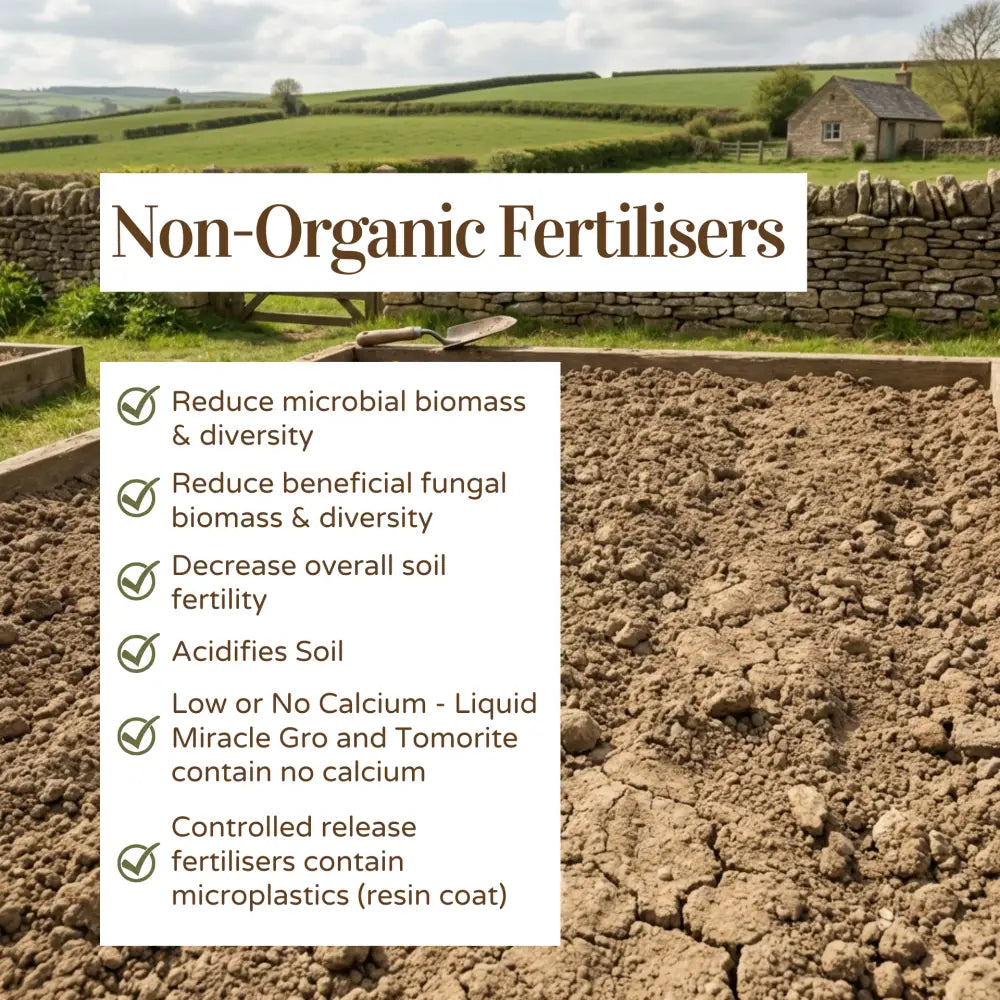
Liquid feeds dissolve salts into the root zone, where the plant must take them up within hours or lose them to leaching. Each application raises electrical conductivity, which opposes the water uptake that carries nutrients into the plant, and most liquid feeds contain no calcium at all — the one nutrient that is immobile and must be continuously present. Dry organic amendments side-step all of this: nutrients release only as microbial enzymes break them down, at a rate that tracks soil temperature and moisture, which is to say plant demand. As the organic fraction decomposes it also builds habitat — microbial colonies, fungal hyphae, and the porous biochar scaffold — which synthetic salts cannot do.
What the research says about organic feeding
The case for organic fertilisation is empirical, not ideological. Large-scale meta-analyses over the last decade have collated thousands of field trials, and the findings are consistent.
Organic fertilisation builds soil carbon
A global meta-analysis found organic fertiliser raised soil organic carbon by 12.9% versus mineral-only, rising to 20.6% under no-dig. Organic inputs supply the carbon substrates that sustain microbial biomass; synthetic salts supply ions but no carbon (Ferro et al., 2022).
Only organic feeding maintains biodiversity
A 2024 meta-analysis of 537 experiments found both organic and inorganic inputs increased plant biomass, but only inorganic decreased plant diversity. Organic maintained or increased it (Xu et al., 2024).
Combined organic-mineral gives the best quality
A meta-analysis of 7,859 data pairs across 551 experiments found combined organic-inorganic inputs produced the greatest nutritional quality, with 25–50% organic substitution optimal — exactly this formula's approach of organic N and P alongside mineral K and Mg (Wang et al., 2023).
Organic nitrogen lowers nitrate accumulation
Organic amendments cut leaf nitrate by around 27% versus equivalent synthetic NPK, with broader analyses reporting 30–50%. Lower nitrate means more carbon goes to flavour, antioxidants and defence rather than bulk tissue (Cardarelli et al., 2023).
Enzyme activity predicts yield
Organic substitution raised soil urease and β-glucosidase activity sharply versus synthetic-only, correlating with 15–20% yield gains — biology predicting yield better than raw chemistry (Liu et al., 2021).
Balanced NPK protects microbial diversity
Phosphorus-deficient conditions alone cut actinobacterial abundance by 23–31% — the organisms behind organic-matter decomposition. The 6-6-6 balance keeps no single nutrient limiting, maintaining microbial function (Shen et al., 2024).
Scientific references
- Marschner, P. ed. (2012). Marschner's Mineral Nutrition of Higher Plants, 3rd ed. Academic Press.
- Barker, A.V. & Pilbeam, D.J. eds. (2015). Handbook of Plant Nutrition, 2nd ed. CRC Press.
- Xu, C. et al. (2024). Effects of organic and inorganic fertilization. Nature Communications, 15, 3555.
- Wang, H. et al. (2023). Nutritional quality of food crops with fertilizer. Agronomy for Sustainable Development, 43, 923.
- Ferro, N.D. et al. (2022). Organic and mineral fertilizers: SOC and crop productivity. Agriculture, 12(4), 464.
- Cardarelli, M. et al. (2023). Organic amendments: biomass and nitrate reduction. Cited in Shen et al. (2024).
- Liu, J. et al. (2021). Organic substitution: enzyme activity and yield. Applied Soil Ecology.
- Shen, W. et al. (2024). Balanced fertilization and soil health. Frontiers in Microbiology, 16, 1536524.
- Li, X. et al. (2024). Organic fertilizer: starch/sucrose metabolism. Nature Scientific Reports, 14, 63564.
- Brundrett, M.C. (2009). Mycorrhizal associations. Plant and Soil, 320(1–2), 37–77.
- Nardi, S. et al. (2009). Humic substances and higher plants. Soil Biology and Biochemistry, 34(11), 1527–1536.
- Lehmann, J. et al. (2011). Biochar effects on soil biota. Soil Biology and Biochemistry, 43(9), 1812–1836.
- Craigie, J.S. (2011). Seaweed extract stimuli. Journal of Applied Phycology, 23(3), 371–393.
- Römheld, V. & Kirkby, E.A. (2010). Research on potassium. Plant and Soil, 335(1–2), 155–180.
- DEFRA / CEH (2016). Countryside Survey: Soil Chemical Properties Technical Report.
- Rothamsted Research. Park Grass Experiment (1856–present).
Frequently asked questions
Share