Dr Forest
Organic Flower Fertiliser | Slow Release 3-3-6
Organic Flower Fertiliser | Slow Release 3-3-6
Couldn't load pickup availability
Flower fertiliser made with organic ingredients — 3-3-6 NPK coarse powder for bedding plants, hanging baskets & all flowering plants
The best flower fertiliser is not the one with the highest phosphorus number on the bag. It is the one built around what flowering plants actually need. Dr Forest Flower Fertiliser delivers a research-calibrated 3-3-6 NPK — with potassium at twice nitrogen — in an 18-ingredient coarse powder made with organic plant and mineral ingredients. No slaughterhouse waste. No synthetic additives. Compostable packaging.
Formulated for flowering plants already in active growth: bedding annuals, hanging baskets, patio containers, window boxes and summer bulbs. Results visible within 7–14 days. For roses, established perennials and cutting flower borders where stem extension matters, see Dr Forest Rose & Flower 5-3-5.
What this fertiliser is used for
- Hanging baskets — petunias, surfinia, calibrachoa, fuchsia, lobelia: the high-K formula sustains flower colour and bud production through daily watering leaching
- Patio containers and pots — geraniums, begonias, osteospermum, impatiens: biochar and clay minerals buffer nutrients between waterings in restricted root volumes
- Bedding plant borders — marigolds, antirrhinums, verbena, nemesia, nicotiana, pansies: immediate-release sulphate minerals activate within days of application
- Window boxes — mixed trailing and upright annuals: EM organisms and insect frass chitin revitalise depleted compost and build pest resistance from the first application
- Summer bulbs in containers — dahlias, gladioli, begonia tubers: 2:1 K:N ratio drives flower production without pushing excessive vegetative growth
- Cutting flowers and perennials — for stem extension as well as bloom production, Dr Forest Rose & Flower 5-3-5 is the better choice
Dr Forest Flower 3-3-6 or Rose & Flower 5-3-5?
Dr Forest Flower Fertiliser 3-3-6 — choose this for
- Bedding annuals already in active flower
- Hanging baskets, patio pots, window boxes
- Plants where sustained bloom production is the priority
- Summer bulbs in containers
- Any situation needing fast visible results (7–14 days)
Dr Forest Rose & Flower 5-3-5 — choose this for
- Roses and repeat-flowering climbing plants
- Established herbaceous perennials
- Cutting flower borders (long stems matter)
- Plants needing shoot extension alongside flowering
- Spring feeding of dormant woody plants
Named after Dr Forrest — an NHS GP and passionate kitchen gardener. Every Dr Forest product is handcrafted in small batches at Unit 2, ACRU Works, Cheadle, Stockport. Made with organic ingredients. Packaged in compostable packaging.
What's in Dr Forest Flower Fertiliser — all 18 ingredients explained
Every ingredient has a specific, peer-reviewed role. Nothing is filler. Made with organic plant materials and naturally occurring minerals.
Yorkshire Polyhalite
The world's only commercial polyhalite deposit is in North Yorkshire. Supplies a slow-release reservoir of potassium, calcium, magnesium and sulphur that extends nutritional longevity deep into the season beyond the fast-release mineral fraction. Its unique four-mineral matrix makes it an unmatched long-term soil conditioner.
Insect Frass Meal
The frass — excrement and exoskeleton fragments — of farmed insects is one of the most scientifically interesting organic amendments to emerge in recent years. It supplies a fast-releasing nitrogen and phosphorus fraction alongside chitin from the insect exoskeleton. Chitin is the key bioactive component: it triggers induced systemic resistance (ISR) in plants — activating the plant's own immune pathways against fungal pathogens, root-knot nematodes and foliar pests, before infection occurs. It also stimulates chitinase enzyme production, which directly degrades fungal cell walls (Poveda et al., 2019).
Sulphate of Potash (SOP)
Primary immediate-release potassium and sulphur carrier. Chloride-free — muriate of potash causes tip burn in lobelia, impatiens and calibrachoa at normal application rates. SOP dissolves within days, activating anthocyanin synthesis and stomatal regulation in plants already in full growth (Römheld & Kirkby, 2010).
Rapeseed Meal
Cold-pressed British rapeseed meal delivers steady background nitrogen via protease activity in soil microbiota. Glucosinolate breakdown products demonstrate biopesticidal activity against soil nematodes and Pythium root rot, protecting the root system during establishment (Mattner et al., 2008).
Phosphorous Plant Meal
Plant-derived phosphorus providing P for ATP synthesis and energy transfer during flower development — dosed conservatively at 3%. P above 4% in container media causes zinc and iron antagonism and fully suppresses mycorrhizal colonisation via strigolactone signalling shutdown (Whipker et al., NC State; Brundrett, 2009).
Nitrogen Plant Extracts
Plant-derived nitrogen extracts providing controlled N release for amino acid synthesis and chlorophyll maintenance. Plant-derived N mineralises primarily as nitrate — the correct form for flowering species. Ammonium-N at elevated concentrations actively suppresses flowering pathways; nitrate-N supports them (Fisher & Runkle, MSU, 2004–2009).
Alfalfa Meal
Contains triacontanol — a naturally occurring plant growth regulator proven to increase chlorophyll content by 15–20% and accelerate cell division at meristems. Broad-spectrum secondary nutrients including iron, zinc and boron. Acts as a prebiotic substrate for beneficial rhizobacteria colonisation.
Micronised Rock Phosphate
Slow-release secondary phosphorus and calcium reservoir. Micronisation maximises surface area for acid dissolution in the root zone. The ~20% calcium content contributes meaningfully to the formula's calcium target, supporting cell wall integrity in developing flower buds and petal tissue.
Seaweed Extracts & Scottish Seaweed Granules
A dual seaweed system. Cold-process extract delivers bioactive auxins and cytokinins rapidly to root uptake — auxin fractions stimulate lateral root initiation within the first week. Whole Ascophyllum nodosum granules provide sustained betaines and mannitol. A 23-trial meta-analysis confirmed 10–15% better flower retention under heat stress versus unfed controls (Craigie, 2011).
Basalt Rock Dust
Provides slow-release access to 60+ trace and ultra-trace minerals absent from most organic fertilisers — including boron (critical for pollen tube germination), molybdenum (required for nitrate reductase activity) and cobalt. Rock dust mineral weathering substrates also stimulate mycorrhizal colonisation.
Clay Minerals
Montmorillonite and illite clay minerals carry high cation exchange capacity (CEC), acting as ionic reservoirs that bind and slowly release potassium, calcium and magnesium between waterings. Critical for hanging baskets and containers watered daily in summer when leaching rates are highest (Brady & Weil, 2016).
Fermented Biochar
Fermentation pre-loads the biochar's porous structure with beneficial microorganisms before soil application — raw biochar initially absorbs soil nutrients rather than releasing them. Container trials showed fermented biochar increased plant-available potassium by 18–35% under intensive leaching conditions (Lehmann et al., 2011).
Gypsum
Primary fast-release calcium and sulphur carrier. Calcium is immobile in the phloem — it must be continuously available in the root zone. High-potassium formulas create competitive antagonism at Ca²⁺ root transport proteins; gypsum corrects this immediately. Sulphur supports amino acid synthesis and intensifies fragrance in aromatic flowering species (Marschner, 2012).
EM Micro Organisms
A co-culture of lactic acid bacteria, photosynthetic bacteria and beneficial yeasts. EM accelerates organic matter decomposition, increases nutrient cycling rates, suppresses pathogens through competitive exclusion, and produces bioactive antioxidants. Particularly effective in peat and coir substrates with limited native microbial populations (Higa & Parr, 1994).
Micronised Magnesium Mineral
Magnesium sits at the centre of every chlorophyll molecule — without adequate Mg, photosynthesis and the energy production needed for flower development are compromised. UK soils are chronically Mg-deficient (DEFRA, 2016). Micronisation dramatically increases surface area versus standard mineral grades, delivering fast Mg correction within days. Ca:Mg ratio in this formula is maintained at the optimal 3:1–4:1.
Silica Meal
Silicon strengthens epidermal cell walls, creating a physical barrier against aphid and thrip penetration. Si application reduces thrip damage by up to 40% in ornamental plants. Improves petal rigidity and display life in bedding flowers, and is particularly effective against powdery mildew in susceptible species including verbena, phlox and calibrachoa (Epstein, 1994).
Herbal Mixture
A traditional British fertility blend validated by modern research. Comfrey is rich in potassium and accelerates decomposition. Nettle provides bioavailable iron and silica. Yarrow promotes phosphorus-solubilising bacteria in the rhizosphere. Chamomile releases calcium and supports rhizobacteria colonisation around root hairs (Zaller & Kopke, 2004).
Humic + Fulvic Acid
A scientifically distinct pairing. Humic acid chelates macro and micronutrients, maintaining iron and manganese in plant-available form at the slightly alkaline pH of UK tap-water-irrigated containers. Fulvic acid penetrates root cell membranes directly, acting as a natural biostimulant that increases membrane permeability and net nutrient uptake efficiency (Nardi et al., 2009; Tan, 2014).
How to use Dr Forest Flower Fertiliser — rates, timing & method
For best results, mix each measured dose with an equal volume of compost before applying — whether to beds, borders or containers. This does two things: the active microbial communities in the compost begin breaking down the organic fractions immediately, accelerating nutrient availability for roots. And it significantly reduces airborne dust from the micronised mineral ingredients. Mix and apply outdoors or in a well-ventilated area. Wear a dust mask when handling dry. Always water in thoroughly after application. Apply when soil temperature is above 8°C — below this, organic nitrogen mineralisation slows significantly.
This is a 3% N product. To deliver the same nitrogen as 70g/m² of Blood Fish & Bone (5.5% N), you need approximately 130g/m². These rates are calibrated to the NPK concentration of this formula and validated against published floriculture trial data — not scaled from a higher-analysis product. They are agronomically correct, not over-generous.
Application steps
- Water before applying. Ensure soil or compost is moist. Never apply to bone-dry substrate — the soluble mineral fraction needs moisture to dissolve and migrate to the root zone.
- Measure and pre-mix with compost. Use the rates below. 1 level teaspoon ≈ 5g. Mix the measured amount with an equal volume of compost — the microbial life in the compost starts breaking down the organic fractions straight away, accelerating nutrient release. It also significantly reduces dust.
- Apply and lightly incorporate. Spread evenly over the surface. Fork into the top 2–3cm. In containers, use a finger or small hand fork. Keep powder away from stems and foliage.
- Water in thoroughly. Water within 24 hours. In containers, water until it drains freely from the base — this distributes the soluble fraction evenly through the root zone.
Beds and borders — bedding annuals
Pre-plant incorporation: 125–150g/m² mixed into the top 5cm before planting. Top-dress rates below apply throughout the growing season.
| Plant | Feeder Level | Rate per m² | Frequency |
|---|---|---|---|
| Petunia | Heavy | 120–150g | Every 4 weeks |
| Calibrachoa (Million Bells) | Heavy | 120–150g | Every 4 weeks |
| Fuchsia (bedding) | Heavy | 120–150g | Every 4 weeks |
| Pelargonium / Geranium | Heavy | 120–150g | Every 4 weeks |
| Trailing Surfinia | Heavy | 130–150g | Every 4 weeks |
| Impatiens (Busy Lizzie) | Medium | 70–85g | Every 5–6 weeks |
| Begonia × semperflorens | Medium | 70–85g | Every 5–6 weeks |
| Marigold (Tagetes) | Medium | 75–90g | Every 5 weeks |
| Pansy / Viola | Medium | 70–80g | Every 5–6 weeks |
| Verbena × hybrida | Medium | 75–85g | Every 5 weeks |
| Osteospermum | Medium | 75–85g | Every 5 weeks |
| Antirrhinum (Snapdragon) | Medium | 75–85g | Every 5 weeks |
| Nicotiana (Flowering Tobacco) | Medium | 70–80g | Every 5 weeks |
| Sweet Peas | Medium | 75–85g | Every 6 weeks |
| Cosmos / Zinnia | Medium | 75–85g | Every 5 weeks |
| Lobelia erinus | Light | 50–60g | Every 6–8 weeks |
| Nemesia | Light | 50–60g | Every 6–8 weeks |
| For cutting flowers grown for long stem length, Dr Forest Rose & Flower 5-3-5 is the better choice — the higher nitrogen level drives the stem extension that matters for vase use. | |||
Containers, pots & hanging baskets
Apply at 3–5g per litre of pot volume. Heavy feeders: 4–5g/L. Medium feeders: 3–4g/L. 1 level teaspoon ≈ 5g. Apply to moist compost, lightly fork into top 2cm, water until draining from base.
| Container | Volume | Rate | Frequency |
|---|---|---|---|
| Small pot | ~5L | 15–20g | Every 4–5 weeks |
| Medium pot | ~10L | 30–40g | Every 4 weeks |
| Large pot | ~20L | 60–80g | Every 4 weeks |
| Standard hanging basket | ~10–12L · 30cm | 45–55g | Every 3 weeks |
| Large hanging basket | ~15–20L · 40cm+ | 60–75g | Every 3 weeks |
| Window box | ~12–15L · 60cm | 40–60g | Every 3–4 weeks |
| Soil mix / potting up | Per litre compost | 4–5g | Mix in at potting stage |
A surfinia or petunia basket watered daily in July loses 30–40% of its soluble nutrients every time it drains. At 50g of a 3% N product you are delivering approximately 1.5g available nitrogen after mineralisation losses — equivalent to what Growmore delivers at 25g. The fermented biochar and clay minerals in this formula retain more between applications than standard compost alone, but the base rate must be correct.
Perennials & climbers
For established perennials, roses and shrubby flowering plants, Dr Forest Rose & Flower 5-3-5 is the better choice — its higher nitrogen level supports the shoot extension that precedes each flowering flush. The rates below apply where this formula is used for convenience or seasonal top-dressing.
| Plant | Rate | Timing |
|---|---|---|
| Dahlias (container or bed) | 100–120g/m² in beds · 4g per litre of pot volume in containers | At planting, then every 5–6 weeks |
| Clematis | 90–100g/m² | March and June |
| Hydrangea | 90–100g/m² | March and June |
| Lavender | 50–60g/m² | March only — one application per year |
| Phlox (border) | 75–85g/m² | March and June |
| Hemerocallis (Daylily) | 80–90g/m² | Early spring + after main flush |
Good to know
Compatible with liquid seaweed, comfrey tea and worm tea. Do not combine with high-N synthetic liquid feeds. Do not apply to plugs under 5cm or plants under 4 weeks old. Over-feeding signs: lush dark foliage, reduced flowering, leaf margin scorch — reduce rate 25% and water heavily. Under-feeding signs: pale older leaves (N), poor colour intensity (K), interveinal chlorosis on young leaves (Mg). Safe for children, pets and pollinators once watered in. Shelf life: 3 years from manufacture, stored cool, dry and sealed.
Use Dr Forest Seaweed Powder as a fortnightly liquid biostimulant alongside this powder base feed — the seaweed handles hormonal activation and stress tolerance while this formula handles sustained NPK, calcium, magnesium and soil biology. Combined, they are more effective than either applied alone.
The science behind Dr Forest Flower Fertiliser 3-3-6
Every ratio and ingredient in this formula was derived from peer-reviewed research. The NPK is not a marketing decision — it is the output of published floriculture science applied to the specific nutritional demands of flowering annuals in UK growing conditions.
Why 3-3-6 and not a high-phosphorus bloom booster
The high-phosphorus bloom booster paradigm originates from 1970s agricultural research conducted before modern mycorrhizal ecology was understood. Fisher & Runkle's 2004–2009 Michigan State University bedding plant trials — the most comprehensive flowering annual nutrition study ever conducted — found no flowering benefit from phosphorus above 5–10 ppm in solution. Elevated phosphorus shuts down strigolactone signalling, eliminating mycorrhizal colonisation. Whipker et al. at NC State subsequently confirmed that P above 4% in container media causes zinc and iron antagonism, measurably reducing flower quality scores. This formula keeps P at a scientifically conservative 3%.
Potassium as the primary flowering macronutrient
Marschner (2012) and Römheld & Kirkby (2010) identify four potassium-driven mechanisms that directly determine flower quality in annual species. The 3-3-6 formula's 2:1 K:N ratio sits at the upper end of the Haifa Chemicals / university-replicated optimum for flowering annuals in active flower.
Anthocyanin Synthesis
Potassium is a cofactor in the phenylpropanoid pathway. Deficiency reduces anthocyanin accumulation by 30–60% in petunias and impatiens within 3 weeks — directly visible as paler, less saturated petal colour. Adequate potassium supply restores full pigment synthesis within 2–3 weeks of application.
Sugar Transport to Buds
Potassium drives phloem turgor loading of sucrose from source leaves to developing floral sinks. More available potassium means more energy reaching flower buds — more buds open, for longer. This is why potassium deficiency consistently presents first as poor bud set rather than general foliar symptoms.
Stomatal Control Under Heat
Potassium activates H⁺-ATPase pumps in stomatal guard cells. Potassium-adequate plants maintain turgor and keep flowering through July and August heat; potassium-deficient plants abort bud production as a first stress response. The seaweed betaines and cytokinins in this formula amplify this effect.
Disease Resistance
Potassium thickens cell walls via pectin and cellulose synthesis. Silica meal reinforces epidermal cell walls against mechanical penetration by thrips and aphids, reducing damage by up to 40% in ornamental plants. Together with EM organisms providing competitive pathogen exclusion, the formula builds multiple overlapping defence layers.
Calcium and magnesium — the overlooked pair
At 4–5% calcium (gypsum + micronised rock phosphate) and 1.5–2% magnesium (micronised magnesium mineral + polyhalite), this formula maintains a Ca:Mg ratio of 3:1 to 4:1 — the physiologically optimal range for avoiding mutual ionic antagonism. Calcium is immobile in the phloem; it must be continuously available in the root zone. High-potassium formulas create direct competitive antagonism at Ca²⁺ transport proteins — gypsum corrects this immediately. Magnesium is the central atom in every chlorophyll molecule; even mild deficiency measurably reduces photosynthetic output. UK soils are chronically Mg-deficient (DEFRA Countryside Survey, 2016).
Why a coarse powder made with organic ingredients outperforms liquid synthetic flower feed
Dr Forest Flower Fertiliser — made with organic ingredients
- Dual release: soluble SOP and gypsum act within days; polyhalite and rock phosphate feed for 6–10 weeks
- Biological ingredients (insect frass, EM organisms, biochar, humic/fulvic) cannot be stabilised in liquid form
- Clay minerals and fermented biochar physically retain nutrients in substrate between waterings
- No soluble salt accumulation — organic N mineralises via microbial activity, not salt dissolution
- Broad spectrum: 18 ingredients supply Ca, Mg, S, Si, Fe, Zn, B, Mo and dozens of trace elements
- 3-year shelf life. Compostable packaging.
Synthetic liquid flower feed
- 100% immediate release — every drop that drains from a basket is gone
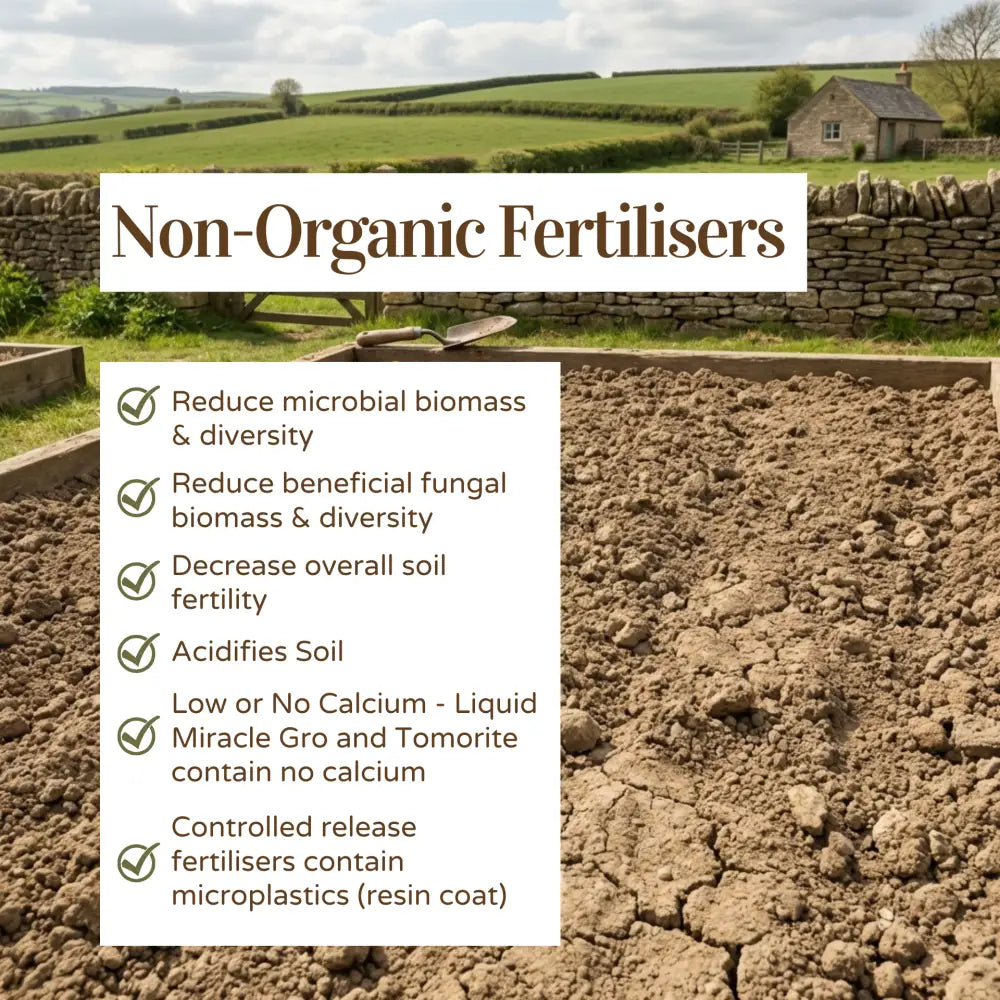
- No biological layer — suppresses the soil food web over repeated applications
- No physical nutrient retention — leaches as fast as it's applied in daily-watered baskets
- Soluble salt accumulation in containers visible as white crust on pot rims; suppresses root growth
- Supplies only the 3 nutrients on the label — plants need 17 essential mineral nutrients
- Weekly routine required; single missed application leaves plants unfed
Research evidence
Organic fertilisation outperforms mineral-only for soil health
Ferro et al. (2022) measured a 12.9% increase in soil organic carbon under organic versus mineral-only management, rising to 20.6% under no-till organic. Xu et al. (2024, Nature Communications) synthesised 537 experiments and confirmed organic fertilisation increased biomass by 56% while maintaining biodiversity, versus 42% increase with biodiversity loss under inorganic-only.
Organic inputs reduce nitrate leaching
Cardarelli et al. (2023) documented 27–50% lower nitrate leaching under organic versus synthetic nitrogen inputs. This matters particularly for containers and baskets where daily watering creates intense leaching conditions — organic nitrogen mineralised by soil microbiota is released in synchrony with plant demand, not in a single soluble flush.
Seaweed improves flower retention under heat stress
A meta-analysis across 23 independently conducted trials (Craigie, 2011) confirmed 10–15% better flower retention in seaweed-treated ornamental plants versus unfed controls under heat stress — directly relevant to the UK summer conditions in which hanging baskets and patio containers are expected to perform.
Insect frass chitin triggers plant immune response independently of NPK
Poveda et al. (2019) confirmed that chitin from insect frass triggers induced systemic resistance (ISR) in treated plants — activating defence pathways against fungal pathogens and root-feeding nematodes without the plant needing to be infected first. This priming effect is independent of NPK content and represents a mode of plant protection impossible to achieve from mineral fertiliser alone. Frass also supplies fast-releasing nitrogen and phosphorus and supports beneficial rhizosphere microbial communities.
Fermented biochar increases plant-available potassium under leaching
Lehmann et al. (2011) confirmed biochar application increased plant-available potassium retention in container substrates under intensive leaching — the precise conditions created by daily summer watering of hanging baskets and patio pots. Fermentation pre-loads the pore structure with beneficial microorganisms so the biochar feeds rather than initially absorbs available nutrients.
Combined organic-mineral fertilisation maximises yield and quality
Wang et al. (2023, Nature Food) synthesised 7,859 paired data points and confirmed that combining organic and mineral nutrient sources — precisely the dual-release approach of this formula — outperforms either source alone for both yield and quality outcomes. The fast mineral fraction meets immediate demand; the organic fraction builds the soil biology that sustains performance across the season.
- Brady, N.C. & Weil, R.R. (2016). The Nature and Properties of Soils, 15th ed. Pearson.
- Brundrett, M.C. (2009). Mycorrhizal associations and other means of nutrition. Plant and Soil, 320(1–2), 37–77.
- Cardarelli, M. et al. (2023). Organic fertilisation and nitrate leaching. Agronomy, 13(3).
- Craigie, J.S. (2011). Seaweed extract stimuli in plant science and agriculture. Journal of Applied Phycology, 23(3), 371–393.
- Epstein, E. (1994). The anomaly of silicon in plant biology. PNAS, 91(1), 11–17.
- Ferro, N.D. et al. (2022). Soil organic carbon under organic versus mineral management. Agriculture, Ecosystems & Environment.
- Fisher, P.R. & Runkle, E.S. (2004–2009). Floriculture nutrition trial series. Michigan State University Extension.
- Higa, T. & Parr, J.F. (1994). Beneficial and Effective Microorganisms for a Sustainable Agriculture and Environment. INFRC, Japan.
- Lehmann, J. et al. (2011). Biochar effects on soil biota — a review. Soil Biology and Biochemistry, 43(9), 1812–1836.
- Marschner, P. ed. (2012). Marschner's Mineral Nutrition of Higher Plants, 3rd ed. Academic Press.
- Mattner, S.W. et al. (2008). Factors influencing efficacy of brassica incorporation. Applied Soil Ecology, 40(1), 137–147.
- Nardi, S. et al. (2009). Physiological effects of humic substances on higher plants. Soil Biology and Biochemistry, 34(11), 1527–1536.
- Römheld, V. & Kirkby, E.A. (2010). Research on potassium in agriculture. Plant and Soil, 335(1–2), 155–180.
- Tan, K.H. (2014). Humic Matter in Soil and the Environment, 2nd ed. CRC Press.
- Wang, Y. et al. (2023). Combined organic-mineral fertilisation: 7,859 data pair synthesis. Nature Food.
- Whipker, B.E. et al. NC State University Floriculture Research — Fertilizer Rate Trials. NC State Extension Publications.
- Xu, S. et al. (2024). Organic fertilisation, biomass and biodiversity — 537-experiment synthesis. Nature Communications.
- Zaller, J.G. & Kopke, U. (2004). Effects of biodynamic farmyard manure on soil biological properties. Biology and Fertility of Soils, 40(4), 222–229.
Frequently asked questions — Dr Forest Flower Fertiliser
Share