Probiotic/Innoculant
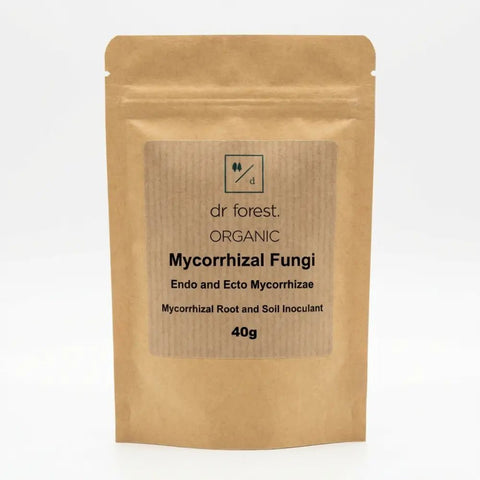
Mycorrhizal Fungi Powder | 18 Species, Endo + Ecto
A plant-based root inoculant, 18 endo and ecto species.
from £6.99
A natural wetting agent for plants is a plant-derived surfactant that lowers the surface tension of water, so water soaks into dry soil and compost instead of running off, and a foliar spray spreads across a waxy leaf instead of beading up. The working ingredient is saponin from organic soap nuts (Sapindus mukorossi). Dr Forest blends it by hand in small batches in Stockport, Greater Manchester, with aloe vera grown on site.
One concentrate does both jobs: a soil wetting agent for peat-based compost, containers and dry patch on a lawn, and a spreader for foliar feeds such as seaweed or fulvic acid. Made with organic ingredients, no petroleum or silicone surfactants, in 500 ml, 1 litre and 5 litre bottles.
Put a drop of water on the surface. If it soaks in within a few seconds, a wetting agent will not do much. If it sits there as a bead for a minute or more, it will. A lawn that is brown because it is hungry wants feeding rather than wetting, and our organic lawn fertiliser is the better answer there. Our guides to what a soil wetting agent does and fixing dry patch on a lawn go through telling the two apart.
It lowers the surface tension of water so the ground will accept it. It does not hold water there afterwards, and it will not reduce how often you need to water. If a thin or sandy soil dries out too fast rather than refusing to wet, what helps is organic matter or a clay amendment such as montmorillonite clay. Products sold as doing both are usually a surfactant plus a polymer. This is the surfactant half, sold as what it is.
No animal-derived inputs. Saponins are not inert. Used at the rates on this page they are a surfactant and nothing more, but natural is not the same as has no effect on anything.
Blended and bottled by hand in small batches at our workshop in Stockport, Greater Manchester. The aloe is grown on site; the soap nuts are imported, since the Sapindus tree does not grow in a British climate. If you have tried washing-up liquid or baby shampoo on a dry lawn, our post on homemade wetting agents explains why the results disappoint. Made by Growers. Backed by Science.
Sapindus mukorossi, the Indian soapberry or washnut, is a deciduous tree of the Himalayan foothills. Its fruit shell carries about 10.1–11.5% triterpenoid saponins by weight (Sochacki and Vogt, 2022, Plants). Each saponin molecule has a water-avoiding backbone with one or more water-loving sugar chains attached, so one end is at home in water and the other is not. That split is the whole of the mechanism.
Dissolved in water, saponins gather where water meets air and lower its surface tension. Pure water sits at about 72 mN/m. A soap nut extract brings that down to roughly 52 mN/m; a strong synthetic surfactant reaches 32 to 37 mN/m (Wojtoń et al., 2021; Rai et al., 2021). A saponin is the milder surfactant. More on the terminology in wetting agent, surfactant or adjuvant: the difference.
| Liquid | Surface tension | What it does on a waxy leaf |
|---|---|---|
| Pure water | about 72 mN/m | Beads up and rolls off |
| Water with soap nut extract | about 52 mN/m | Spreads into a film |
| Water with a strong synthetic surfactant | 32–37 mN/m | Spreads further still |
The gap between 72 and 52 is the one a gardener cares about: the difference between water that beads and water that wets. The extra drop a synthetic achieves matters in industrial spraying and less on a lawn or a pot. On the leaf, a spread film stays put longer than a bead and dries more slowly; the vegetable glycerine slows that drying further. The aloe adds a little viscosity, and we make no wetting or film-retention claim for it.
Soil turns water-shedding when long-chained organic compounds build up on and between the particles (Doerr, Shakesby and Walsh, 2000, Earth-Science Reviews). Sandy soils are the most prone, since there is less particle surface to coat. Peat does the same once dry: below roughly 40% water by weight it becomes very hard to rewet, and the drier it gets the worse it is (Durand et al., 2021, Agronomy). Lowering the surface tension lets water wet those coated surfaces instead of running past them.
On water-shedding ground, water finds the cracks, runs along pot walls and leaves the middle of the root zone dry however long you stand there with the hose. Wetting agents restore uniform wetting and rewetting of peat-based growing media; the same trial found that overdosing at three to ten times the label rate harmed plants, which is why the lower end of the range is the place to start (Nemati and Jeong, 2017, Acta Horticulturae).
On a severely water-shedding golf green, a surfactant applied weekly through June raised soil moisture in the top 20 cm and produced statistically significant improvements in turf quality 10 to 12 days after the first application, with deeper rooting to match. Below the thatch the soil stayed water-shedding, which is why repeat treatment rather than a single dose is the norm (Aamlid, Espevig and Kvalbein, 2009, Biologia).
Saponins start working at a lower dose in soft water than in hard. In one measurement the concentration needed rose from 0.32 g/L in deionised water to 2.4 g/L in tap water, and the review literature agrees that hardness pushes that threshold up (Wojtoń et al., 2021; Sochacki and Vogt, 2022). Hence reverse osmosis water in the bottle, and rainwater or filtered water for diluting where you can.
Saponins lower surface tension and also interact with cell membranes; the two properties have been studied together (Böttger, Hofmann and Melzig, 2012, Bioorganic and Medicinal Chemistry). At the dilutions on this page the product is a surfactant and nothing else, but we would rather you knew the molecule has a wider life than pretend a plant extract does nothing at all.
Rates below are given in teaspoons and in millilitres. One level teaspoon is 5 ml. A standard 9 litre watering can takes 45 ml, which is nine teaspoons, and covers 9 square metres at the lawn rate, and at the top of the soil drench range. For other areas, the wetting agent calculator does the sums.
This is a naturally derived concentrate containing saponins that settle over time. Shake or stir vigorously before measuring and diluting. Soft water (rainwater, filtered, or dechlorinated) gives best results. Hard water can reduce saponin effectiveness.
Add to any foliar spray to improve leaf coverage and absorption. Mix with seaweed, fulvic acid, or foliar fertilisers. Apply as a fine mist to both upper and lower leaf surfaces. The saponins reduce surface tension, allowing the spray to spread and adhere rather than beading off.
When: early morning or late evening, never in strong midday sun. A spread film on a hot leaf in full sun dries too fast to be absorbed and can mark the foliage. How long for: use it in every foliar spray for as long as you are spraying. There is nothing to build up and nothing to rest between.
Apply to dry or water-shedding soil and growing media. Particularly effective for peat-based composts that turn water away once dried out. Water the solution across the surface and allow it to soak through. The reduced surface tension enables even moisture distribution throughout the root zone.
First, on a badly dried pot: if the compost has shrunk away from the sides, water once with plain water to settle it back against the walls, then apply the diluted solution. Otherwise the solution simply runs down the gap. How long for: a container that has dried right out usually takes two or three waterings with the solution before it wets evenly again. Once it does, go back to plain water and use the wetting agent again only when it next dries out hard. More on containers in why pots and baskets stop taking water.
Water newly transplanted seedlings and plants with a dilute solution so that water makes immediate contact with the roots rather than running around the root ball. Particularly valuable when planting into dry soil, or when the root ball has dried out in transit.
When: at the time of planting, as the first watering in. How long for: once is enough. Water normally after that.
Apply to lawns suffering from dry patch or a water-shedding thatch layer, the brown areas that stay crisp however much you water them. The reduced surface tension lets water move down through the thatch and into the root zone. Particularly useful after scarification or aeration, when the exposed soil surface can dry out and turn water away.
When: early morning or evening, on a cool or overcast day, never on turf in strong midday sun. Water the treated area in with plain water afterwards, roughly another litre per square metre, so the solution carries down into the thatch rather than sitting on it.
How long for: in the UK the useful window is roughly May to September, when the ground actually dries out enough to start shedding water. Applying in a wet spring achieves nothing. Established dry patch rarely clears on one application. The RHS cultural programme for dry patch is spiking and hollow-tine aeration with thorough watering, repeated once a month for three to four months. On wetting agents themselves the RHS says only that repeat treatment is likely to be necessary, in conjunction with those cultural methods. So read the monthly rhythm as the cultural programme the wetting agent accompanies: apply monthly through the dry spell alongside spiking and thorough watering, and keep watering normally in between. A wetting agent lets water in; it does not supply it.
Add to compost teas, aerated brews, or microbial inoculants to improve application spread. Improves soil contact and distribution of biological inputs.
When: at the point of application rather than at the start of the brew, and apply the brew the same day.
Judge it on water, not on colour. The morning after treating, put the hose or can on the treated ground and watch what the water does. If it now sinks in where it previously beaded and ran to the edges, the wetting agent has done its job. Green-up is a separate and slower thing: it follows over the following week or two, and only where the grass crowns are still alive. Where the grass has actually died off, the patch will need reseeding once the ground is accepting water again.
Hard water contains calcium and magnesium ions that can interact with saponins and reduce their surfactant effectiveness. For best results, use rainwater, filtered water, or water that has been left to stand and dechlorinate. If only hard tap water is available, the product will still work. You may just need the higher end of the dilution range.
Use alongside Organic Seaweed Extract Powder for foliar sprays where leaf coverage matters, with Fulvic Acid Powder for chelated foliar feeding, and with any Dr Forest crop-specific fertiliser applied as a liquid feed. On a lawn, pair it with Organic Lawn Fertiliser: the wetting agent gets the water in, the feed does the growing.
Keep cool, dark and tightly capped. The concentrate keeps for at least 12 months from opening. Use diluted solution within 24 hours; the dilute solution is not preserved. Shake before each use.
9% of buyers here also chose Mycorrhizal Fungi Powder
A plant-based root inoculant, 18 endo and ecto species.
from £6.99
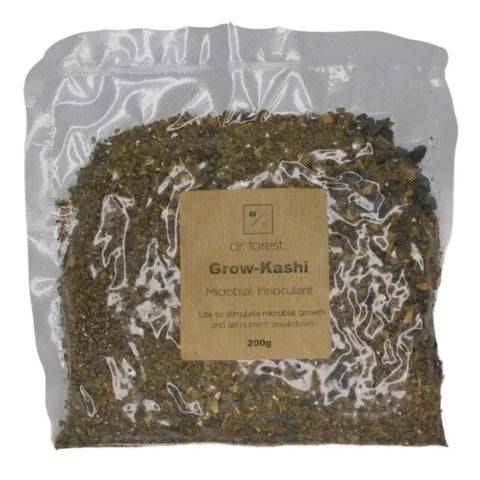
A bokashi soil conditioner to build living soil.
from £7.50