


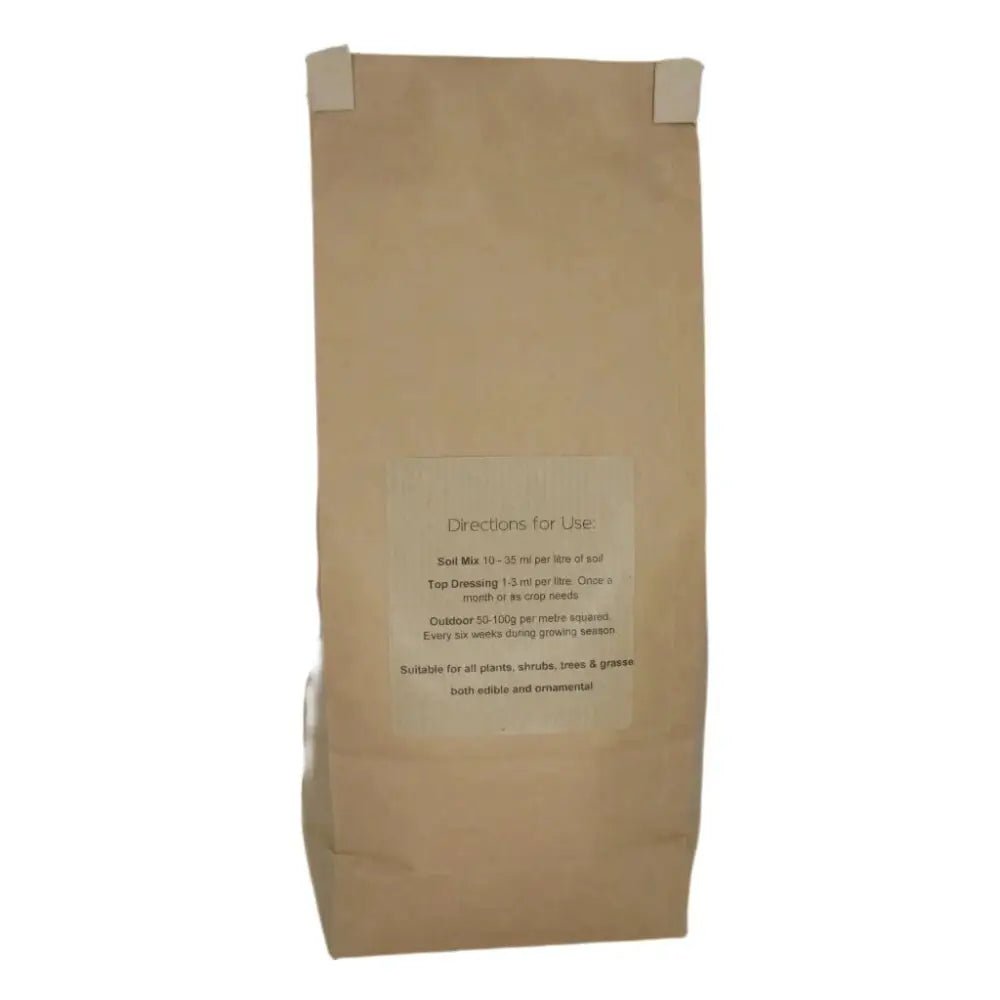
a mineral soil improver that works in weeks and keeps working for years
Dr Forest Mineral Mix is a six-mineral soil conditioner and soil improver: volcanic basalt, gypsum, clay minerals and sea shell meal in one bag, blended in small batches in Stockport. Compost and manure add organic matter. This adds the mineral side: calcium and sulphur that release within weeks, a slow reserve of silicon, magnesium and trace elements that weathers out over years, and clay that gives light or peat-free soil the capacity to hold nutrients between waterings.
Rock dust is the part most gardeners underrate. In a four-year field trial in the US Corn Belt led by the University of Sheffield, crushed basalt raised maize yields by 12% and soybean by 16%, and lifted potassium, magnesium, manganese, phosphorus and zinc in the harvested grain (Beerling et al., 2024). Sheffield's own controlled-environment trial on basalt-amended soil recorded sorghum seed yields up 21% and shoot silicon up 26% (Kelland et al., 2020). Those trials used agricultural rates, and scattering a handful over open ground is lighter than that. Mix it into a potting or raised-bed medium, though, and the basalt goes in at roughly 1 to 3% of the mix by weight, which is a serious dose in a small volume of soil.
Two of the six minerals come in both a fine and a coarse grade, and that is the whole design. Micronised basalt and micronised gypsum have an enormous reactive surface, so calcium, sulphur and trace elements start arriving in the first few weeks. The granulated basalt is the same rock left coarse, and the granulated gypsum is a coarser mineral again; both weather slowly and carry on releasing for years afterwards. The clay minerals hold what is released instead of letting it wash through, and the sea shell meal is a long calcium reserve behind all of it. One bag feeds the season you are in and the ones after it.
Growers building high-quality living soil have been doing this by hand for years: rock dust for the mineral reserve, clay for holding capacity, gypsum for calcium and sulphur. This does it in one bag, at percentages printed on the page rather than hidden behind "enriched with minerals".
One honest limit: it is a soil conditioner, not a fertiliser. There is no useful nitrogen, phosphorus or potassium in it, so it sits under a feeding programme rather than replacing one. Use it when you are making up a soil mix, remineralising a tired bed, or conditioning sandy and peat-free ground that lets nutrients wash straight through.
The humic and fulvic acid fraction has come out. The mix is now six mined and marine minerals and nothing else. If you want humic acid alongside it, Humic Acid Flakes are sold separately so you can set the rate yourself.
What people use it for
- Building a potting or raised-bed mix — peat-free composts are often low in minerals and low in cation exchange capacity. Mixing this in at the start is the most effective way to use it.
- Remineralising a tired bed or allotment plot — years of cropping and rain take calcium, magnesium and trace elements out of the top few inches. This puts a mineral reserve back.
- Conditioning sandy or free-draining soil — the clay minerals give light soil somewhere to hold calcium, magnesium and potassium instead of leaching them.
- Calcium and sulphur without moving the pH — gypsum is calcium sulphate. It supplies both without the pH rise you get from lime, so it suits neutral and alkaline ground as well as acid.
- Planting trees, shrubs, roses and hedging — a few handfuls in the backfill gives roots a mineral reserve for the years they will spend in that hole.
- Lawn soil conditioning — the fine fractions settle between the blades; the granular fractions and clay work into the root zone over the season.
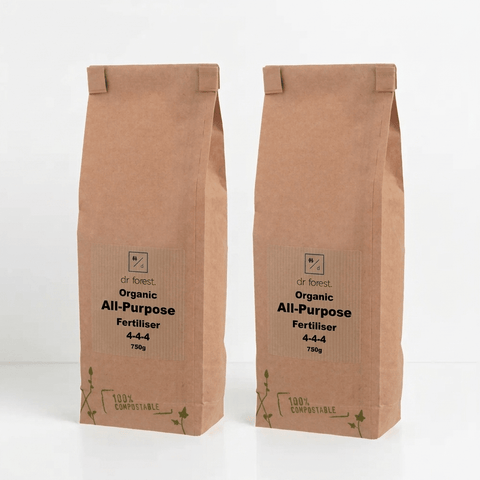
- Serious growers running a living soil — this is the mineral base under stage feeding with All Purpose 4-4-4 and Bloom 2-8-4.
Mineral mix vs a bag of soil improver from the garden centre
Dr Forest Mineral Mix
- Mined and marine minerals only. Adds calcium, sulphur, silicon, magnesium, trace elements and cation exchange capacity.
- Does not add organic matter. Pair it with compost, leafmould or manure for the whole job.
- A 1.5 kg bag treats 10 to 30 m² of bed at the maintenance rate.
Bagged "soil improver" (composted green waste or bark)
- Adds organic matter, which is what improves structure, water-holding and biology. Worth doing.
- Mineral content depends on what went into the compost heap. Calcium and sulphur are rarely stated and often low.
- Applied by the barrowload, not the handful. Different tool for a different half of the job.
Mined and marine minerals only. No slaughterhouse by-products.
six minerals, by weight
The recipe is one part each of micronised basalt, granulated basalt, micronised gypsum, granulated gypsum and clay minerals, and a quarter part of sea shell meal. By weight that is 19% of each of the five main minerals and 5% shell. Every ingredient is listed here, with its job.
Micronised volcanic rock dust (basalt) — 19%
Basalt is a volcanic rock that carries silicon, calcium, magnesium, iron and a spread of trace elements in one mineral. Weathering happens at the surface of the grain, so grinding it fine multiplies the reactive area and soil acids and root exudates get to work on it within the first season rather than the tenth. Laboratory work on seven tropical soils has recorded rises in cation exchange capacity and in exchangeable calcium, magnesium and potassium from finely ground basalt, with only a fraction of what was applied becoming available at once and the rest held in reserve (Gillman et al., 2002). This is the fast half of the basalt. The same product is sold on its own as Volcanic Rock Dust.
Volcanic rock granules (basalt) — 19%
The same basalt, left coarse. Granules weather far more slowly than powder, which is exactly the point: they are the reserve still releasing in year three, when the micronised fraction has long since been used up. They also give the blend enough body to spread evenly by hand instead of blowing away. Sold separately as Granulated Rock Dust.
Micronised gypsum — 19%
Naturally mined calcium sulphate of high purity, ground fine: around 32% CaO and 45% SO₃. Gypsum dissolves slowly (about 2.5 g per litre of water) so it does not spike salt levels, but the fine grind puts a lot of surface in contact with soil water and calcium becomes available over weeks rather than months. Because it is a sulphate and not a carbonate, it supplies calcium without raising soil pH. On dispersive clay it also helps the clay particles flocculate so water can drain (Shainberg et al., 1989). We also sell micronised gypsum wet-milled and held in suspension as Liquid Gypsum.
Granulated gypsum — 19%
A different gypsum from the micronised fraction, screened into 2–5 mm granules rather than milled. Its analysis is 40% SO₃, 30% CaO and 3% MgO, so alongside calcium and sulphur it brings a little magnesium, which most agricultural gypsums carry none of. Granules dissolve over months, so calcium and sulphur are still arriving late in the season once the fine fraction has gone. Sold on its own as Granulated Gypsum.
Clay minerals (montmorillonite) — 19%
A swelling clay with a very high cation exchange capacity. Its job in the mix is to give sandy soil and peat-free compost somewhere to hold positively charged nutrients such as calcium, magnesium and potassium so they are not lost to the next heavy watering. In a five-year trial on a sandy loam, a single bentonite application raised field water-holding capacity in the top 40 cm by up to 9%, 11% and 12% across the three seasons that followed (Mi et al., 2020). The rates in that trial, 6 to 30 tonnes per hectare, were far higher than a garden would use; the direction of effect is what matters here. Sold separately as Montmorillonite Clay.
Sea shell meal — 5%
Crushed marine shell, mostly calcium carbonate. It is in the recipe at a low rate as a slow calcium reserve that dissolves over years. Crushed shell has a liming potential very close to that of calcium carbonate: 3.4 to 3.8 tonnes per hectare to lift a soil to pH 6.5 in one trial (Lee et al., 2008). At 5% of the mix, and at garden rates, it nudges pH upward only slightly. If you need to correct an acid soil, use Sea Shell Meal or Garden Calcium Carbonate on their own, at a liming rate.
What the mix supplies
| Nutrient | Typical | From | Speed |
|---|---|---|---|
| Calcium (CaO) | ~18% | Both gypsums ~12%, shell ~2.5%, basalt the rest | Weeks to years |
| Sulphur (SO₃) | ~16% | Both gypsums | Weeks to months |
| Magnesium (MgO) | ~3% | Basalt, granulated gypsum | Slow, years |
| Silicon (SiO₂) | Substantial | Basalt, clay minerals | Slow, years |
| Iron and trace elements | Present | Basalt | Slow, years |
| Nitrogen, phosphate, potash | None to speak of | — | Use a fertiliser |
Figures use the oxide convention printed on fertiliser labels. Calcium and sulphur are calculated from the stated analysis of the two gypsums and the shell. The basalt and clay contributions are typical totals for those rocks rather than a measured figure, and only a fraction of them becomes plant-available in any one season.
Every ingredient is mined rock, mined gypsum, clay or crushed shell. There are no slaughterhouse by-products and no manures in the mix. Because of the shell, it is not sold as vegan.
how to use mineral mix
The mix weighs roughly 1.2 g per ml, so a level tablespoon is about 15 to 18 g and a 250 ml cup about 300 g. Soil-mix rates are given by volume (ml per litre of compost) because that is how people make up a mix; bed and lawn rates are by weight per square metre. Wear gloves and avoid breathing the dust, as with any fine mineral powder.
Application rates
Making up a soil mix (pots, containers, raised beds)
Mix in thoroughly before planting. Use 10 to 15 ml per litre for loam-based or home-made composts that already carry some mineral content, 15 to 20 ml for a standard multipurpose, and up to 30 ml for very mineral-poor peat-free mixes. Building the minerals into the medium at the start does more than any later top-dressing can.
Top-dressing established pots and containers
Scatter over the surface and water in. For a 20 litre pot that is 20 to 40 ml, about two tablespoons. The fine fractions wash in with the first watering; the granules and clay follow over the weeks after.
Beds, borders and vegetable plots
Scatter and rake into the top few centimetres, then water. Use the top of the range for a first application on ground that has never had a mineral amendment, and 50 g per m² for maintenance once the soil has been mineralised. A 1.5 kg bag covers 10 to 30 m² at a time.
Lawns
Broadcast evenly and water in. On sandy lawns the clay minerals and gypsum help the root zone hold water and calcium. Pair it with a lawn feed for nitrogen; the mix supplies none.
Planting trees, shrubs, roses and hedging
Mix through the soil that goes back around the roots. The gypsum gives readily available calcium to new roots; the granules and clay stay in the root zone for years.
Rates at a glance
| Situation | Rate | Frequency |
|---|---|---|
| Soil mix, loam-based | 10–15 ml/L | Once |
| Soil mix, multipurpose | 15–20 ml/L | Once |
| Soil mix, mineral-poor peat-free | up to 30 ml/L | Once |
| Top-dress pots | 1–2 ml/L | Once per season |
| Beds, first application | 100–150 g/m² | — |
| Beds, maintenance | 50 g/m² | Every 6 weeks |
| Lawns | 50–100 g/m² | 1–2 per season |
| Planting backfill | 50–75 g | Once |
Step by step
- Weigh or measure it. 10 to 30 ml per litre for a soil mix; 50 to 150 g per m² on beds. A level tablespoon is about 15 to 18 g.
- Mix in or scatter. For a soil mix, turn it through until the pale flecks are evenly spread. On beds and lawns, scatter and rake lightly. On pots, sprinkle around the base of the plant.
- Water in. Moisture starts the gypsum dissolving and washes the fine fractions off the surface.
- Feed as normal. The mix carries no NPK. Keep your usual fertiliser going alongside it.
- Store it dry. The clay is hygroscopic and will clump in a damp shed. Clumps still work; break them up and use as normal.
The 5% shell will lift pH a little over years; the gypsum will not lift it at all. If a soil test says your ground is acid and needs correcting, that is a job for Garden Calcium Carbonate at a proper liming rate, not for this.
Under a feeding programme it pairs with All Purpose 4-4-4 for growth and Bloom 2-8-4 for flowering and fruiting. For the organic-matter half of soil improvement, compost or leafmould does the job; if you want a bagged option, Alfalfa Meal Pellets add organic matter and some nitrogen at the same time.
Read more on what a soil improver is and which kind you need, and on how to top-dress.
what the evidence says, and where it is thin
Soil improvement splits into two jobs. Organic matter builds structure, water-holding and biology; that side is well proven and it is what compost does. The mineral side is about what the soil is made of: how much calcium, magnesium and potassium it can hold, whether it has a reserve of slowly weathering rock to draw on, and whether calcium and sulphur are there when a crop wants them. Mineral Mix works on that second side. Here is what each part rests on.
Cation exchange capacity is what stops nutrients washing through
Soil holds positively charged nutrients (calcium, magnesium, potassium, ammonium) on negatively charged surfaces. Sandy soil and most peat-free composts have very few of those surfaces, so the nutrients you add leach out with the rain. Clay minerals, particularly the swelling smectites such as montmorillonite, carry a large negative charge per gram, which is why adding them raises a soil's capacity to hold cations (Bohn et al., 2001). The five-year bentonite trial mentioned on the Ingredients tab put numbers on the water-holding side of this: up to a 12% rise in field water-holding capacity after a single application (Mi et al., 2020).
A four-year field trial put numbers on basalt
The strongest recent evidence for rock dust comes from a University of Sheffield-led trial in the US Corn Belt, published in PNAS. Crushed basalt applied to a maize and soybean rotation over four seasons raised maize yield by 12% and soybean by 16% against untreated controls, and raised potassium, magnesium, manganese, phosphorus and zinc in the harvested grain, with no significant rise in trace metals in the grain or in the soil's exchangeable pools (Beerling et al., 2024). The rate was 50 tonnes per hectare a year, far above anything a garden broadcasts, so read it as evidence that basalt does what is claimed of it rather than as a yield promise for a handful on a bed.
Basalt raised yield and silicon in Sheffield's own trial
In Sheffield's controlled-environment work on basalt-amended agricultural soil, sorghum seed dry mass rose by 21 ± 9.4% and shoot silicon by 26 ± 5.4%, with the base cations released by weathering accumulating in the soil's exchangeable pools rather than washing away (Kelland et al., 2020). That last point matters more than the yield figure: it is the mechanism by which a slow rock keeps feeding a soil, and it is why the granulated fraction in this mix is there.
Finely ground basalt raises exchangeable calcium, magnesium and potassium
In column trials on seven weathered soils, finely ground basalt raised pH, lowered aluminium saturation, and increased cation exchange capacity and exchangeable calcium, magnesium and potassium. Only a fraction of the applied cations became exchangeable straight away; the rest stayed as a reserve, and the improvements held after a full wet season of simulated rainfall was leached through (Gillman et al., 2002).
Rock dust is slow, and the evidence on temperate soils is mixed
Set against that, a 2022 review of silicate rock powders is the honest counterweight. Basalt is among the rock types with the most consistent benefits and weathering speeds up with finer grinding and more rainfall, but the clearest results come from highly weathered tropical soils; on temperate field soils, which usually still hold a decent mineral reserve, the review found results inconclusive, and field weathering runs far slower than the laboratory suggests (Swoboda et al., 2022). Two things follow. A good loam that already grows well may not show you much. A container of peat-free compost, a sand, or a plot cropped hard for a decade is a different case, and much closer to the mineral-poor soils where rock dust earns its keep. That is also why this mix pairs basalt with gypsum, which works in weeks rather than years.
Gypsum supplies calcium and sulphur without changing pH
Gypsum is calcium sulphate. It has no carbonate, so its neutralising value is zero and it will neither correct an acid soil nor push an alkaline one further. What it does is supply calcium and sulphate sulphur in a form that dissolves slowly, and on dispersive clay soils the dissolved calcium helps clay particles flocculate so that water can move through (Shainberg et al., 1989). A 2017 review of gypsum in agriculture describes it as widely used and under-explained, with the strongest effects on sodic and dispersive soils, and a crop response running soybean ahead of maize ahead of wheat (Zoca & Penn, 2017). Most liquid feeds carry no calcium at all, which is one reason to have a mineral source of it in the soil.
Sulphur is the nutrient UK soils have quietly run short of
Atmospheric sulphur deposition in Britain fell steeply after the 1980s as coal burning and industrial emissions were cut. A Rothamsted risk assessment across 6,301 sites put 11% of British land at high risk of sulphur deficiency and a further 22% at medium risk, and projected both figures would roughly double as sulphur dioxide emissions fell further (McGrath & Zhao, 1995). Sulphur is needed for protein synthesis and for the flavour compounds in onions, brassicas and garlic. The two gypsum fractions give the mix about 16% SO₃, most of it available within the season.
Silicon is taken up and laid down in cell walls
Silicon, which most gardeners call silica, is not classed as essential for most plants. Grasses and cereals take it up in quantity, often to higher levels than any other mineral in the plant, and plants short of it are structurally weaker and more easily stressed (Epstein, 1999). How much a plant takes up varies a great deal by species: among vegetables the cucurbits accumulate it and most others do not (Ma & Yamaji, 2006). Basalt is silicon-rich. The silicon in it releases slowly, so this is a long-term reserve rather than a quick effect.
Fast and slow fractions of the same mineral
Dissolution and weathering rates scale with surface area, so a micronised powder releases far faster than a granule of the same rock. Putting both forms of basalt and both forms of gypsum in one mix gives a front-loaded supply for the current season and a reserve that continues after it. It also means the mix can be spread by hand without the whole bag blowing away.
Scientific References
- Beerling, D.J., Epihov, D.Z., Kantola, I.B., Masters, M.D., et al. (2024). Enhanced weathering in the US Corn Belt delivers carbon removal with agronomic benefits. Proceedings of the National Academy of Sciences, 121(9), e2319436121.
- Kelland, M.E., Wade, P.W., Lewis, A.L., et al. (2020). Increased yield and CO₂ sequestration potential with the C₄ cereal Sorghum bicolor cultivated in basaltic rock dust-amended agricultural soil. Global Change Biology, 26(6), 3658–3676.
- Gillman, G.P., Burkett, D.C. & Coventry, R.J. (2002). Amending highly weathered soils with finely ground basalt rock. Applied Geochemistry, 17(8), 987–1001.
- Swoboda, P., Döring, T.F. & Hamer, M. (2022). Remineralizing soils? The agricultural usage of silicate rock powders: a review. Science of the Total Environment, 807, 150976.
- Mi, J., Gregorich, E.G., Xu, S., McLaughlin, N.B. & Liu, J. (2020). Effect of bentonite as a soil amendment on field water-holding capacity, and millet photosynthesis and grain quality. Scientific Reports, 10, 18282.
- Bohn, H.L., McNeal, B.L. & O'Connor, G.A. (2001). Soil Chemistry, 3rd ed. Wiley.
- Shainberg, I., Sumner, M.E., Miller, W.P., Farina, M.P.W., Pavan, M.A. & Fey, M.V. (1989). Use of gypsum on soils: a review. Advances in Soil Science, 9, 1–111.
- Zoca, S.M. & Penn, C. (2017). An important tool with no instruction manual: a review of gypsum use in agriculture. Advances in Agronomy, 144, 1–44.
- Lee, C.H., Lee, D.K., Ali, M.A. & Kim, P.J. (2008). Effects of oyster shell on soil chemical and biological properties and cabbage productivity as a liming materials. Waste Management, 28(12), 2702–2708.
- McGrath, S.P. & Zhao, F.J. (1995). A risk assessment of sulphur deficiency in cereals using soil and atmospheric deposition data. Soil Use and Management, 11(3), 110–114.
- Epstein, E. (1999). Silicon. Annual Review of Plant Physiology and Plant Molecular Biology, 50, 641–664.
- Ma, J.F. & Yamaji, N. (2006). Silicon uptake and accumulation in higher plants. Trends in Plant Science, 11(8), 392–397.
- Marschner, P. (Ed.) (2012). Marschner's Mineral Nutrition of Higher Plants, 3rd ed. Academic Press.
your questions
Often bought with this
29% of buyers here also chose Organic All Purpose Fertiliser 4-4-4
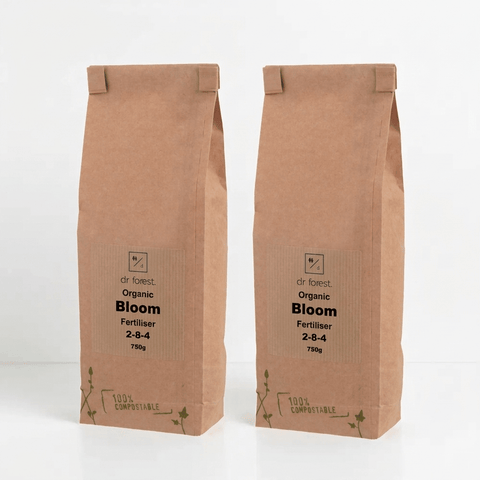
Organic Bloom Fertiliser 2-8-4 | High Phosphorus Flower Feed
High-phosphorus 2-8-4 for flowering and fruiting.
from £12.00

Cal-Mag for Plants | pH-Neutral Calcium & Magnesium Feed
Adds calcium and magnesium for firm growth and fewer deficiencies.
from £10.49


