Probiotic/Innoculant
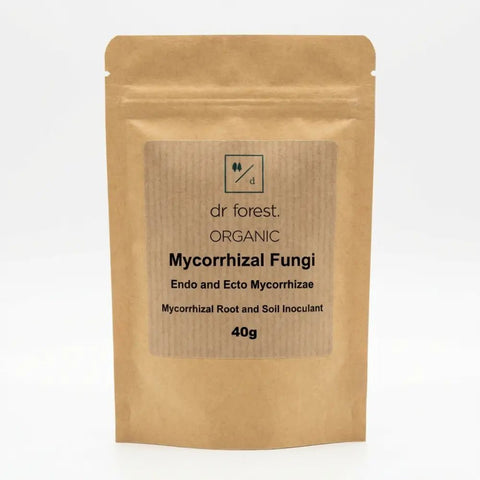
Mycorrhizal Fungi Powder | 18 Species, Endo + Ecto
A plant-based root inoculant, 18 endo and ecto species.
from £6.99
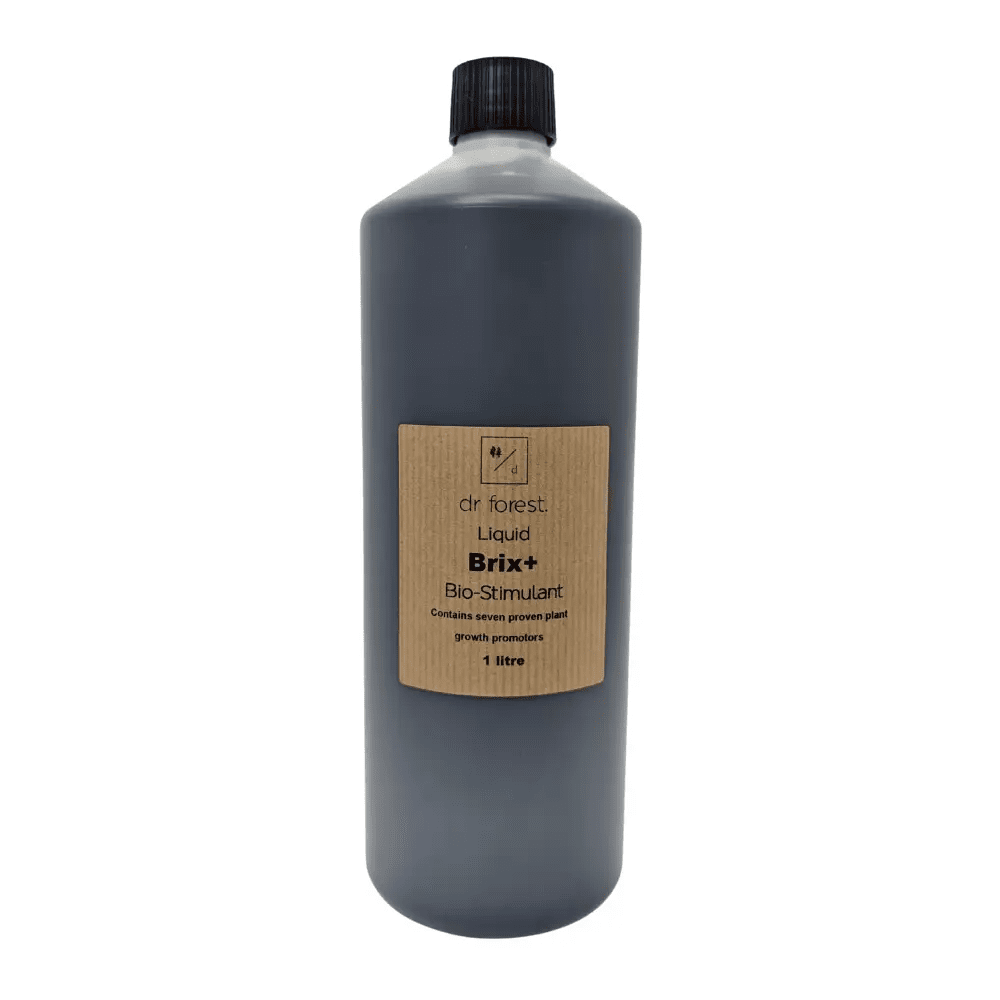
Brix+ is a concentrated liquid seaweed biostimulant that carries triacontanol, cytokinins, gibberellins, auxins, betaines, mannitol and a fraction of natural acids and phenolics, plus 74 ocean-derived trace minerals. Used little and often as a foliar spray or soil drench, it nudges the plant's own growth signalling: more photosynthesis, more sugar in the sap, better root establishment and a buffer against frost, drought and heat.
The name comes from Brix (°Bx), the refractometer reading for sugar in sap and fruit juice. Brix+ is not a primary fertiliser: nitrogen is 0.26% and potassium 1.65%, so it goes alongside a proper feed. Sold in 500 ml and 1 litre bottles; at 2 to 2.5 ml per litre a litre makes 400 to 500 litres of spray.
Brix+ is a plant-based liquid from Dr Forest, Stockport, Greater Manchester, and sits in the same family as our soluble seaweed extract powder. If you want the background on what seaweed does for plants before you buy, read benefits of seaweed fertiliser for plants. Made by Growers. Backed by Science.
A refractometer reads how much light bends passing through a drop of juice and reports it as degrees Brix, roughly the percentage of dissolved solids. In fruit that is mostly sucrose, glucose and fructose, with acids, amino acids and minerals making up the rest. A tomato at 4°Bx tastes watery; at 8°Bx it is properly sweet. In fruit, the reading is a fair guide to how much sugar the plant has made and stored.
Brix is often sold as a measure of pest and disease resistance as well. The controlled evidence for that is thin, so we leave it out. The research does support two narrower points: triacontanol raises photosynthetic output [2], and fruit from seaweed-treated crops measures sweeter [9].
| Component | Value | Note |
|---|---|---|
| Natural acids, phenolics, amino acids, 74 trace minerals, cytokinins, gibberellins, auxins, betaines, mannitol | 17.5% | Declared as one combined figure |
| Total nitrogen (N) | 0.26% | Trace; not a nitrogen feed |
| Total potassium (K) | 1.65% | |
| Sulphur (S) | 0.37% | |
| Magnesium (Mg) | 0.15% | |
| pH | 5.0–5.8 | Mildly acidic; jar test before tank mixing |
| Conductivity | 30–50 mS/cm | Concentrate; falls to negligible at 2.5 ml/L |
| Specific gravity | 1.0 | 1 ml weighs 1 g, so ml and g are interchangeable |
| Appearance | Brown liquid | Can mark pale fruit if sprayed near harvest |
The nutrient numbers are deliberately low; a biostimulant is judged on what it signals, and the working strength (2 to 2.5 ml per litre) is a 1:400 to 1:500 dilution. The most widely researched seaweed for plant biostimulants is Ascophyllum nodosum, the North Atlantic rockweed, a rich source of alginic acid (28%), fucoidans (11.6%), mannitol (7.5%) and laminarin (4.5%) [6]. The betaine and hormone fractions are tiny by weight, which is the puzzle of how these products work.
Triacontanol is a 30-carbon fatty alcohol from the wax of alfalfa and other leaves, reported as a new plant growth regulator by Ries and colleagues in Science in 1977 [1]. A 2012 review in the Journal of Plant Interactions collects the field record: activity at nanomolar concentrations, a roughly 30% increase in Rubisco in treated rice, wheat yield gains averaging 12% and rice gains of 17 to 21% [2]. It is the reason Brix+ is applied so dilute.
Put triacontanol on the shoots of rice seedlings and an adenosine-type second messenger appears in the roots within a minute; in rice and maize, free amino acids, reducing sugars and soluble protein rise within five minutes [2]. Islam and Mohammad (2020, Physiology and Molecular Biology of Plants) add the stress side: under salt, drought and heavy-metal stress, treated plants held higher antioxidant enzyme activity and chlorophyll than controls [3]. More is not better: in one trial the review cites, a tenfold stronger dose gave a weaker response [2].
Wally and colleagues (2013, Journal of Plant Growth Regulation) measured what an Ascophyllum extract did to Arabidopsis hormone genes: cytokinin biosynthesis genes went up and cytokinin breakdown genes went down at 24 and 96 hours, while auxin biosynthesis genes were repressed [7]. They concluded that the hormone levels in the extract are too low to have much effect at recommended rates, and that other components may modulate the plant's own hormone pathways. That is the honest reading of "seven growth promoters": most of the effect probably comes from what the plant then makes for itself.
Whapham, Blunden and colleagues (1993, Journal of Applied Phycology) showed that tomato plants given an alkaline Ascophyllum extract, on the soil or the leaves, carried more leaf chlorophyll than controls; using a cucumber cotyledon test, they traced the effect at least in part to three betaines [8]. Craigie's 2011 review describes betaines as cytoplasmic osmoticants and notes their proposed role in easing drought, frost and salinity stress [5]. This is the basis for spraying before a frost or a dry spell: you are topping up what a cell uses to hold water when conditions turn.
Shukla and colleagues (2019, Frontiers in Plant Science) review the Ascophyllum trials: a lipophilic fraction let Arabidopsis recover from −5.5°C with reduced electrolyte leakage; 1 g/L extract given to 10-day-old alfalfa plants more than doubled the rhizobial bacteria in the rhizosphere twelve hours after inoculation; a root drench improved the growth of strawberry and carrot and raised soil microbial activity [6]. Khan and colleagues (2009) reach similar conclusions on root growth and mycorrhizal colonisation [4]. Hence the drench at planting, paired with a mycorrhizal inoculant.
Pei and colleagues (2024, PLOS ONE) pooled 73 field studies of seaweed-based products. Yield rose 15.17% on average, fruit crops 20.27%. Soluble sugar rose 17.96%, vitamin C 18.07% and the sugar-to-acid ratio 38.32% against controls. Foliar application gave a slightly larger yield response (13.70%) than root application (11.10%) [9]. These were Chinese field trials, so the exact figures may not carry over to a British garden; the yield gain held in every crop group.
For the alfalfa origin of triacontanol and what it does in a dry feed, see what is alfalfa meal, and is it a good fertiliser?
Figures describe the published literature on seaweed extracts and triacontanol and are not product-specific yield guarantees.
Specific gravity is 1.0, so 1 ml is 1 g. Half a 5 ml medicine spoon is 2.5 ml, the top of the foliar range for a litre; a 5 litre sprayer takes 10 to 12.5 ml.
Brix+ is designed to be used at low concentration and high frequency. It is preferable to increase the frequency of applications rather than the concentration of the solution. The growth promoters work through signalling pathways that respond to repeated, regular stimulation rather than single high-dose applications. Stick to the dilution rates below and apply regularly through the growing season.
Shake well before use. Mix 2–2.5 ml of Brix+ per litre of water and apply as a fine spray to both upper and lower leaf surfaces, in early morning or late evening when stomata are open and evaporation is low. Foliar is the quickest route in. Suitable for all plants including lawns, shrubs, roses, tomatoes, vegetables and fruit.
Mix 5–12.5 ml of Brix+ per litre of water and apply around the root zone with a watering can. The organic acids and phenolics feed rhizosphere microbial activity while the trace minerals and growth promoters are taken up by the roots; a drench gives a longer-lasting, deeper effect than a spray. Use the lower rate (5 ml/L) for regular maintenance and the higher rate (12.5 ml/L) for plants under stress or during peak fruiting demand.
For growers running a two-part liquid feed, add Brix+ to the Part B solution before combining with Part A, or add it directly to the final working solution at 16 ml per 10 litres (1.6 ml/L). The Part B rate assumes roughly 50× dilution into the final reservoir, so do not put 0.4 L per 5 L into the finished tank. Do not pre-mix with concentrated feeds; always dilute into the working volume. The growth promoters and trace minerals supply the biostimulant and micronutrient side that synthetic liquid feeds usually lack.
Spray at the standard foliar rate immediately before a forecast frost, drought or heat event to prime the betaine and mannitol osmoprotection. If the event has already happened, spray as soon as conditions allow to support recovery: cytokinins delay senescence in damaged tissue, betaines steady the remaining cell membranes and triacontanol restarts photosynthesis.
Shake or stir well before every use. Do not mix with low-pH solutions; run a jar test to confirm compatibility with other products before tank mixing. Avoid spraying close to harvest on produce prone to staining, as the brown liquid can mark pale-skinned fruit. Do not pre-mix or store in diluted form. Use within 6 months of opening.
Brix+ delivers the signal; a base fertiliser delivers the building blocks. Use it alongside Organic All Purpose Fertiliser 4-4-4 during vegetative growth and switch to Organic Bloom Fertiliser 2-8-4 at flowering. Tank-mix with our soluble seaweed extract powder for a double seaweed pass, one for the hormone signal and one for mineral density. Apply our activated biochar condensate (wood vinegar) as a soil drench on alternate weeks for complementary karrikin signalling and microbial stimulation. Add humic acid flakes to soil drenches; the humic acid chelates the trace minerals in Brix+ for root uptake.
Store sealed in a cool, dry place out of direct sunlight. Crystallisation or sedimentation may occur below 5°C; this is normal and does not affect quality. Warm gently and shake to re-dissolve. Keep away from children and pets.
16% of buyers here also chose Mycorrhizal Fungi Powder
A plant-based root inoculant, 18 endo and ecto species.
from £6.99
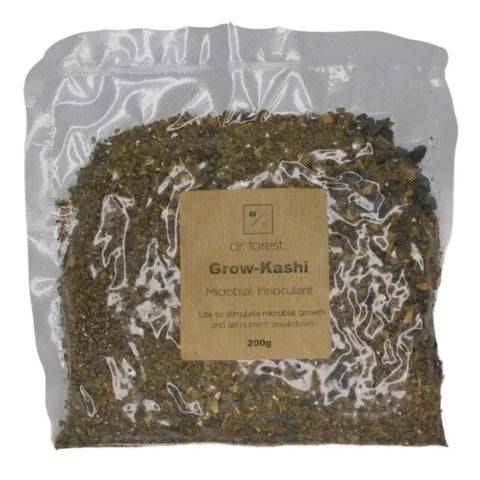
A bokashi soil conditioner to build living soil.
from £7.50
Helps water and feed soak in evenly, with less run-off.
from £14.00